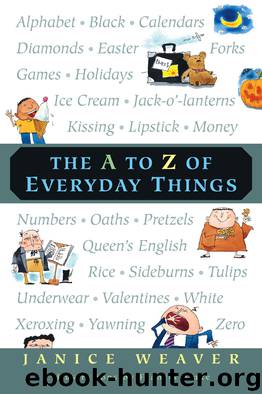
The a to Z of Everyday Things by Janice Weaver
Author:Janice Weaver [Weaver, Janice]
Language: eng
Format: epub
ISBN: 978-1-77049-904-1
Publisher: Tundra
Published: 2004-11-08T16:00:00+00:00
N
Numbers
The fear of the number thirteen is so widespread that we have coined a special term — triskaidekaphobia — to describe it. People the world over refuse to work on the thirteenth floor, live in house number 13, or make major decisions on the thirteenth of the month. A Friday that falls on the thirteenth is a worse omen to many people. Even those who claim not to be superstitious will avoid making significant purchases or traveling on Friday the thirteenth, and some refuse to show up for work. All told, triskaidekaphobia and its mouth-twisting counterpart, paraskevidekatriaphobia (fear of Friday the thirteenth), cost world economies billions of dollars a year.
One commonly held belief is that the fear of thirteen has its origins in the biblical Last Supper, whose thirteenth — and final — guest was Judas Iscariot, the betrayer of Christ. Certainly this is where we get another popular superstition — the belief that if you ever sit down to dinner with just twelve other people, one person at the table (usually the last to sit or the first to rise) will die within the year. But in fact there is some evidence that the fear of thirteen predates the Bible. The Romans considered it a symbol of death, and it’s a supremely unlucky number in both Norse and Hindu mythology. In tarot decks, thirteen is the death card, and witches’ covens usually have thirteen members.
Thirteen is not the only number believed to have magical properties, however. In the West, there are several so-called sacred numbers, and most of those do have some relationship to the Bible. Three, for instance, recalls the Holy Trinity; in modern life, we talk of three guesses and three wishes, of good things coming in threes, and of the third time being “the charm.” Some of the Bible’s sacred numbers take their cue from nature. Four, for example, represents not only the Christian cross and the four gospels, but also the four points on the compass, the four seasons of the year, and the four phases of the moon. Twelve is the number of Jesus’ apostles, as well as the number of months of the year and hours in each half of the day. There are also twelve signs in the zodiac, which has important symbolism for cultures all over the world.
Download
This site does not store any files on its server. We only index and link to content provided by other sites. Please contact the content providers to delete copyright contents if any and email us, we'll remove relevant links or contents immediately.
The Rise and Fall of Senator Joe McCarthy by James Cross Giblin(5281)
Paper Towns by Green John(5191)
The Giant and How He Humbugged America by Jim Murphy(3450)
The Science Book (Big Ideas Simply Explained) by DK(3287)
Eleanor & Park by Rainbow Rowell(3176)
The President Has Been Shot!": The Assassination of John F. Kennedy by Swanson James L(3103)
The Rape Of Nanking by Iris Chang(2824)
Merriam-Webster's Collegiate Thesaurus, Second Edition by Merriam-Webster Inc(2761)
Harry Potter and the Deathly Hallows (7) by J.K. Rowling(2725)
Ancient Worlds by Michael Scott(2689)
Beautiful Oblivion by Jamie McGuire(2608)
Eligible by Curtis Sittenfeld(2586)
Dork Diaries 12 by Rachel Renée Russell(2366)
Sharp Objects by Gillian Flynn(2304)
The Unlikely Pilgrimage of Harold Fry by Rachel Joyce(2273)
Frankly, Frannie by AJ Stern(2210)
The Astronomy Book by DK(2159)
Forensics by Val McDermid(2094)
Who Was Louis Braille? by Margaret Frith(1982)
